History of LLMs and Why This Is Important to You
From neural networks in the 1960s to AI writing production code today — what the last five years mean for your business, and why the trend isn't going away.
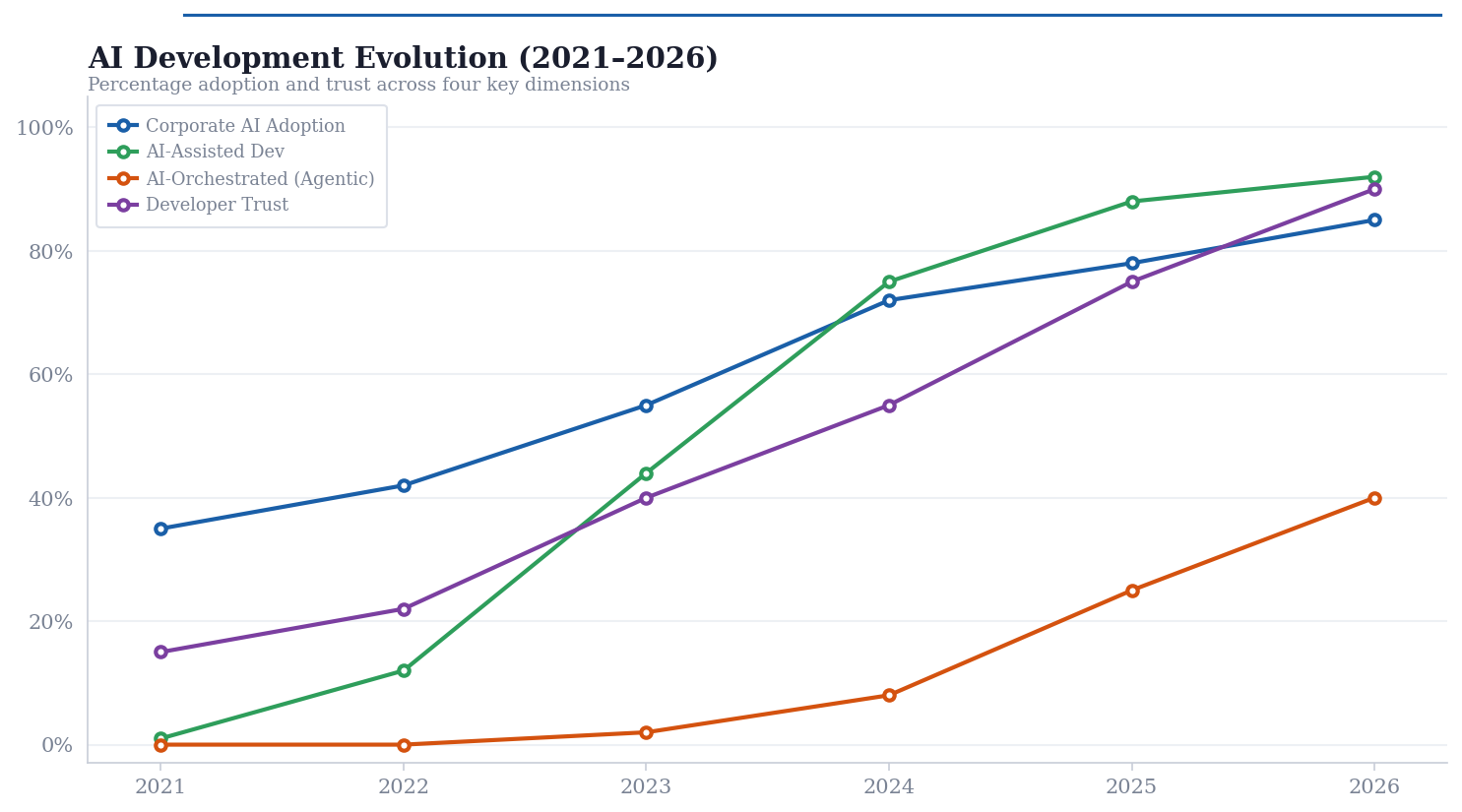
You could argue that the conceptual foundations of AI started in the early 1900s with writers imagining smart robots, scientists envisioning neural networks, and the creation of the Turing Test. You could study the early research and development from the 1960s–80s that helped establish the AI foundation we work on today. You may have experienced some of the early AI implementations of the 1990s and early 2000s — remember Deep Blue and Watson? The focus narrows as you learn about the first implementation of convolutional neural networks (CNNs) and the transformer architecture that paved the way for large language models (LLMs). But it is the last five years that demand the most attention. LLMs have turned the corner in terms of capability, accuracy, and availability. All of the lines in this chart are important to observe, but for us, the most important are 1) developer trust and 2) AI orchestration.123
Developer Trust
When LLMs first became widely available and accessible five years ago, they had very unpredictable responses — hallucinations and confidently wrong answers were common. Look where that number is today: developer trust around 90%. We're not just using LLMs for code-assist anymore; we're writing code with them. Do we still — and will we always — vet responses? Yes. But we feel considerably better about them today and utilize LLMs more than ever.45910
AI Orchestration
As for orchestration, the data speaks for itself — as the graph shows, all of the major players in software development are adopting this. The important thing to note is the trend: this is not going away. At Maxwell AI, we are committed to constantly working to leverage AI orchestration, concepts, and tools into our processes to help guide your business through the AI transformation.678